Concerned over UK PM Starmer’s planned meeting with Yunus, the Bangladesh Awami League

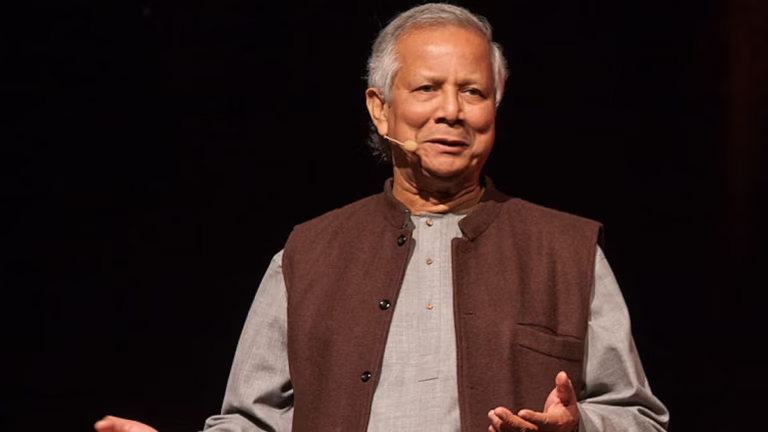
The Bangladeshi Awami League has expressed deep concern over UK Prime Minister Keir Starmer’s reportedly scheduled meeting with Chief Adviser Muhammad Yunus.

“The Awami League has today expressed deep concern over UK Prime Minister Sir Keir Starmer’s reportedly scheduled meeting with Muhammad Yunus, the self-declared Chief Adviser of Bangladesh, warning that any formal meeting lends legitimacy to an unelected and unconstitutional administration,” the Awami League posted on its Facebook page.

A formal letter from the Awami League’s UK branch has been sent to Downing Street, the Speaker of the House of Commons, the King’s Foundation, and the Commonwealth Secretariat, urging British officials not to unwittingly launder Yunus’s administration, just as Bangladesh’s crisis deepens, it added.

Bangladesh’s Chief Adviser Muhammad Yunus will be on a bilateral official visit to the United Kingdom from June 10 to 13, 2025.

During the visit, the Chief Adviser is expected to have an audience with King Charles III of the United Kingdom. He is also scheduled to hold a bilateral meeting with the UK Prime Minister during the visit.

Muhammad Yunus recently announced that the general election will be held in the first half of April 2026. The announcement of the election is a major development for Bangladesh politics after the fall of the Sheikh Hasina-led Awami League government in August 2024.

Elections in Bangladesh are scheduled for April of next year: President Muhammad Yunus

Chief Adviser of Bangladesh’s interim government, Muhammad Yunus, announced on Friday that the country’s next general elections will be held in the first half of April 2026, despite demands from major political parties to hold the polls by December. Addressing the nation on the eve of Eid-ul-Azha, Yunus emphasized the government’s commitment to organizing the most free, fair, and competitive elections in Bangladesh’s history, following extensive consultations and ongoing institutional reforms. However, the opposition Bangladesh Nationalist Party (BNP) expressed disappointment at the delayed timeline, reiterating their call for elections by December 2025 due to concerns over Ramadan, student examinations, and weather conditions.

Turkey and Bangladesh want to build joint defence production plants in Narayanganj and Chittagong.

As Bangladesh continues to procure military hardware from China, it is simultaneously deepening strategic defence ties with Turkey. During a recent visit to Turkey, BIDA Executive Chairman Chowdhury Ashik Mahmud Bin Harun held extensive discussions on establishing defence industrial clusters in Chittagong and Narayanganj. The visit included rare access to the facilities of Turkish defence giant Makine ve Kimya Endustrisi (MKE), with talks focusing on co-production, technology transfer, and capacity building.

This engagement builds on earlier defence acquisitions from Turkey, including MKE howitzers and TRG rocket systems, and signals a shift toward industrial integration. Future collaborations are expected to be formalized through a memorandum of understanding and overseen by a proposed Defence Industrial Working Group. These initiatives fall under the incentives of the Bangladesh Economic Zones Act 2010, underscoring the country’s push for defence self-reliance and strategic diversification.

At the Dhaka airport, a human trafficking attempt was stopped; two Chinese and one Bangladeshi were detained.

Security personnel at Hazrat Shahjalal International Airport arrested three individuals, including two Chinese nationals, in connection with an attempted human trafficking operation involving a young Bangladeshi woman. Acting on a tip-off from the victim, authorities swiftly apprehended the suspects, uncovering evidence of a broader trafficking network. Investigators found that one suspect had posed as a prospective groom, using financial incentives and threats to manipulate the victim. A fraudulent passport and travel arrangements were made for her to be sent to China, but she was rescued just before departure. Law enforcement officials continue to crack down on trafficking rings exploiting vulnerable women.

Shafiqur Rahman, the leader of Bangladesh’s Jamaat-e-Islami, would depart for Doha tomorrow.

The stalled humanitarian corridor linking Bangladesh and Myanmar’s Rakhine State remains a controversial geopolitical issue. Strong opposition from the Bangladesh Army and political parties like the BNP has intensified concerns over security risks and regional stability.
Bangladesh’s National Security Adviser Khalilur Rahman recently visited Doha, Qatar, reportedly to invite Qatar Amir Tamim bin Hamad Khalifa Al Thani’s daughter to visit a Rohingya camp in Cox’s Bazar. However, sources suggest he may have also met U.S. officials to discuss the stalled corridor proposal. Meanwhile, Jamaat-e-Islami chief Shafiqur Rahman is also headed to Doha, though details of his visit remain unclear.
The Bangladesh Army has voiced concerns over the corridor’s potential to empower non-state armed groups like the Arakan Army, leading to heightened political and security challenges.

As the Army restates its stance on the “humanitarian corridor” and sovereignty, Bangladesh’s NSA Khalilur Rahman is in Doha.

“Bangladesh’s National Security Adviser Khalilur Rahman quietly left Dhaka for an official visit to Doha amid controversy over the proposed humanitarian corridor to Myanmar’s Rakhine State. Meanwhile, the Bangladesh Army reaffirmed its commitment to national sovereignty and border security, emphasizing its role in maintaining stability. Colonel Mohammad Shafiqul Islam stated the Army would not support any decisions endangering national security, including foreign involvement in developing the Lalmonirhat air base. The visit coincides with escalating political concerns, as BNP continues to oppose the humanitarian corridor and calls for Khalilur Rahman’s removal as NSA.”

Foreign Secretary Jashim Uddin is prohibited from leaving his post by the Yunus administration.

The Mohammad Yunus-led interim regime in Bangladesh has restrained Mohammad Jashim Uddin from fully stepping down after he opposed the proposed humanitarian corridor aiding Myanmar’s Arakan Army. His stance led to diplomatic fallout, including the expulsion of Bangladesh’s Defence Attaché in Yangon. The government also recalled Shabab Bin Ahmed from The Hague, reportedly over his social media comments supporting Jashim Uddin’s position.

A serious betrayal: The BDR mutineers’ release is a disrespect to the fallen soldiers of the Bangladesh Army.

On May 15, 27 former Bangladesh Rifles (BDR) members walked free from Kashimpur jails in Gazipur, securing bail in a case linked to the 2009 Pilkhana mutiny. The revolt, which left 74 people dead, including 57 army officers, remains one of Bangladesh’s darkest chapters.
The judiciary’s decision to grant bail has sparked concerns over justice and institutional integrity, with critics calling it a betrayal of the Bangladesh Army’s fallen officers. The release raises questions about political expediency and historical accountability, as families of the victims continue to seek closure.